
When the jaw will not rest, even while you sleep.
Diagnostic-led treatment for TMJ dysfunction, clenching, and the headaches that travel with them, from a practice that looks at the airway at the same time.
TMJ dysfunction is a disorder of the jaw joint and the muscles that move it. It causes jaw pain, clicking, restricted opening, and clenching, and it frequently shows up as headaches, ear symptoms, or neck tension rather than as obvious jaw trouble.
Treatment here begins with measurement: the bite, the muscles, and the joint are recorded before any appliance is designed.
Signs of TMJ dysfunction
- Jaw pain, tightness, or fatigue, often worst in the morning
- Clicking, popping, or catching when you open or close
- Clenching or grinding, noticed by a partner or visible as worn teeth
- Recurring tension headaches, ear fullness, or neck and shoulder pain
- Difficulty opening wide, or a bite that has stopped feeling right
Why measurement comes first
Jaw pain is easy to treat badly. A flat night guard is the usual first offer, and it does protect enamel, but it does not answer why the muscles are working all night, and in an airway patient it can make things worse. The alternative is to record what is actually happening before deciding what to do about it.
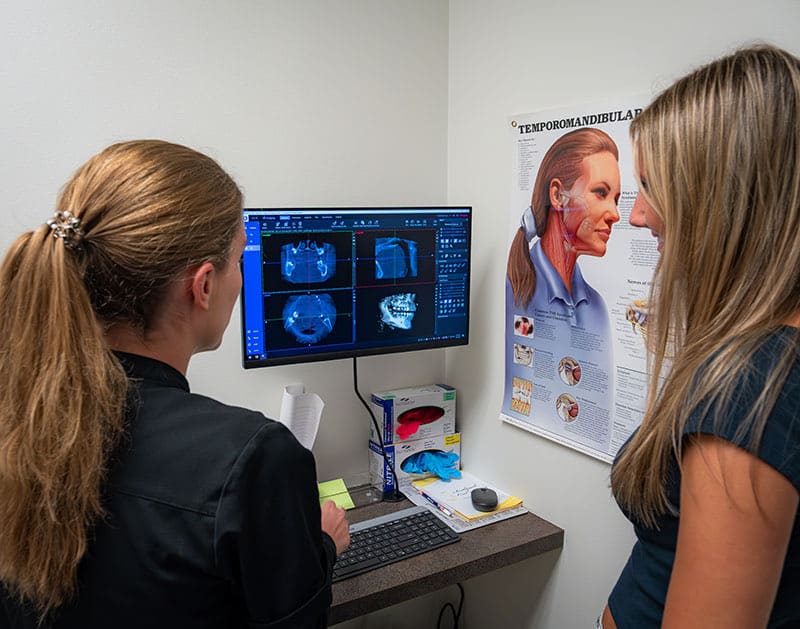
Three measurements most offices do not take.
T-Scan digital bite analysis
A sensor records exactly where your teeth make contact, how hard, and in what order. It turns 'your bite feels off' into a timed map of force.
EMG muscle readings
Electromyography shows which jaw muscles are working, how hard, and whether they ever actually rest.
Cone-beam 3D imaging
A single scan showing the joint and the airway together, which is the whole point when clenching and breathing may be related.
Why TMJ patients often arrive complaining about something else.
The jaw muscles refer pain, and the joint sits directly against the ear. That is why a jaw problem is so often described as a headache problem, an ear problem, or a balance problem, and why it gets treated in the wrong place for years.
Headaches
The temporalis and masseter refer pain into the temples, the forehead, and behind the eyes. A headache that is worst on waking, or that arrives with a tight jaw, is worth examining the bite and the muscles for before it is treated as migraine alone.
Ear symptoms
Fullness, pressure, or ringing with no ear findings is a common report in temporomandibular disorders, because the joint sits immediately against the ear canal. Get an ENT opinion first; if the ear is clear, the jaw is the next place to look.
Dizziness and balance
Dizziness is reported alongside temporomandibular disorders often enough to take seriously, though the causal link is still debated. We do not claim the jaw explains every case, and dizziness should be worked up by a physician or ENT before anyone treats it as a jaw problem.
Where the honest line sits. These symptoms are commonly reported together with jaw disorders. That is an association, not proof that your jaw is the cause. Measuring the bite, the muscles, and the joint before treating is precisely how a symptom that belongs to a neurologist or an ENT gets sent to one instead.
How treatment works
With real data, treatment stops being trial and error. Care is conservative and specific to what the measurements show: neuromuscular orthotic therapy to reposition and rest the jaw, bite correction where it is indicated, coordination with your physician when sleep is part of the picture, and EMFACE, which is FDA-cleared for the treatment of TMJ dysfunction, where jaw-muscle spasm is driving the pain.
The connection we do not want you to miss
If you clench at night and wake up unrefreshed, the jaw and the airway may be describing the same problem. That is why both are evaluated here, and why treating them together often works when treating either one alone has not. If sleep is part of your picture, start with sleep apnea and the CPAP alternative.
A patient of the practice describing the jaw and vertigo symptoms that brought her in. One person's experience is not a prediction of yours.
TMJ and sleep, answered.
What is TMJ dysfunction?
TMJ dysfunction, also called TMD, is a disorder of the temporomandibular joint and the muscles that move the jaw. It presents as jaw pain, clicking or popping, restricted opening, clenching and grinding, and frequently as headaches, ear symptoms, or neck and shoulder tension.
What does the jaw have to do with sleep?
Sleep-related bruxism, the clenching and grinding that happens while you are asleep, often occurs alongside disrupted breathing. In a practice that treats both, the jaw and the airway are evaluated together rather than as two unrelated complaints in two different offices.
How is this different from the night guard my dentist offered?
A flat night guard protects tooth surfaces from wear. It does not explain why the jaw is straining, and in some cases it can make an airway problem worse by allowing the jaw to fall back. Here the bite is measured with T-Scan, the muscles with EMG, and the joint and airway with cone-beam 3D imaging before anything is made.
Is treatment surgical?
Almost never. The great majority of TMJ care here is conservative: orthotic therapy to reposition and rest the jaw, bite correction where it is indicated, and EMFACE where jaw-muscle spasm is the dominant problem. If a case genuinely needs a surgeon, you will be referred.
Do you bill medical insurance for TMJ care?
Often, yes. TMJ dysfunction is frequently a medical rather than a dental matter, and we verify what your specific plan covers before treatment starts rather than after.
Can TMJ cause headaches or dizziness?
Jaw-muscle disorders commonly refer pain into the temples and the back of the head, and patients often describe ear fullness or dizziness alongside jaw symptoms. That does not mean the jaw is the cause in every case, which is why the evaluation measures rather than assumes, and why we coordinate with physicians when symptoms point elsewhere.
My headaches were diagnosed as migraine. Is it worth looking at my jaw?
It can be, particularly if the headache is worst on waking, sits in the temples, or arrives with a tight or sore jaw. That does not replace a neurologist's diagnosis and it does not mean the migraine diagnosis is wrong. It means an overworked jaw muscle can be a separate, treatable contributor sitting on top of it.
My ears feel full but the ENT found nothing. What now?
That is a common path into a TMJ evaluation. The temporomandibular joint sits directly against the ear canal, and joint or muscle problems are frequently described as ear fullness, pressure, or ringing. Having the ear cleared first is the right order; the jaw is the next thing to examine.
How long does TMJ treatment take?
It depends on what the measurements show and how long the problem has been running. Conservative orthotic therapy is usually a course of visits over weeks to months rather than a single appointment, with the device adjusted as the muscles change. You should be given a realistic picture at the consultation rather than a number over the phone.
Clinically reviewed by Dr. Kathryn Sudikoff, DMD, Diplomate of the American Board of Dental Sleep Medicine.Reviewed

Let us find out why your jaw will not settle.
A short conversation is the fastest way to find out whether we can help. Most sleep and TMJ care here is billed to medical insurance.